

What was Australia’s currency before the 1919 penny was first minted on Australian soil? In colonial times, coins in use were produced overseas in Mother England or in India. Even earlier, the bartering of goods in high demand and the use of coins from other countries was accepted tender.
The main coins in circulation in the colony of NSW were English sovereigns, shillings and pence, Spanish reales, Indian rupees and Dutch guilders. While sailors, convicts, soldiers and merchant ships from around the world making their way to an Australian port on the east coast from 1770, coins from other countries were in common use.
In 1800 Governor Phillip Gidley King placed fixed values on some of the most common coins in an attempt to stabilize the currency. He set the silver Spanish dollar’s value at 5 shillings. Unfortunately, many of these coins soon left the country on ships from America, Asia and the Cape of Good Hope, leading to a shortage of coins.
In 1812, Governor Macquarie requested that Australia be able to mint its own currency due to a serious shortage of coins in the colony. In response, the British government sent 40,000 silver Spanish dollars (pieces of eight or reales) which arrived in November 1812 from Madras, aboard the ship Samarang.
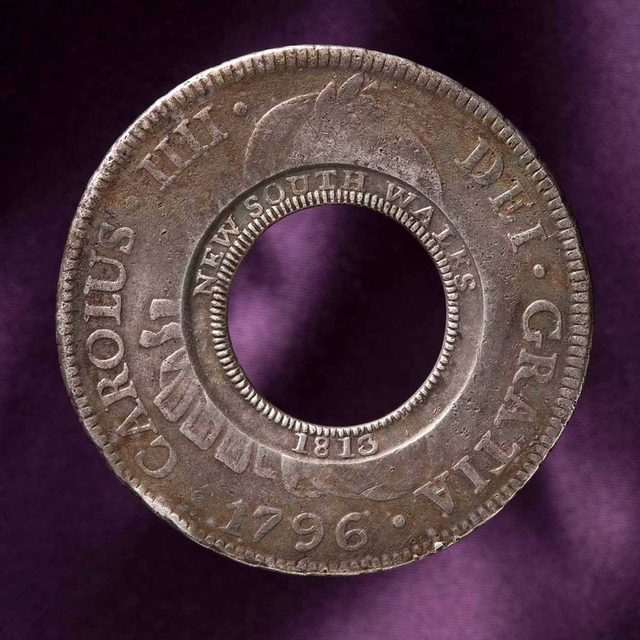
Macquarie then ordered William Henshall, a convict transported for forgery, to cut a piece from the centre of each coin. The coins were stamped to identify them as currency of the colony of New South Wales. This rendered the coin useless outside the colony, solving the problem of the currency leaving the country, and quickly doubled the number of coins in circulation. The piece cut from the centre was called the dump and valued at 15 pence. The outer ring of the coin was called the holey dollar and its value set at 5 shillings. It took Henshall some time to produce the machinery needed to convert these Spanish pieces of eight. The resulting coins were stamped with their value and “NEW SOUTH WALES 1813. Henshall also worked his initial “H” into a spray of leaves in the design of the holey dollar and on the reverse of the dump.
Holey dollars and dumps were to be the colony’s legal tender for the next 16 years. One rare, quite well-preserved example of the holey dollar is held in the National Museum of Australia with only about 300 examples of the dollar and about 1000 examples of the dump known to exist today. Many were recalled and melted down to strike later coinage.
In 1852, a gold coin known as the Adelaide pound was issued when South Australia found itself extremely short of coinage. Made at the Adelaide Assay Office using gold from the Victorian goldfields, it was not approved by Britain and was never legal tender.
A few years after federation the 1909 Coinage Act was passed, which provided for the production of uniquely Australian coins. By 1910 the very first Australian coins were issued, namely the florin, shilling, sixpence and threepence. In 1911, the first penny and halfpenny were issued.
The Royal Australian Mint in Canberra was built in preparation for decimalisation ‘Changeover Day’, which occurred in February 1966. This day saw Australia’s currency of pounds, shillings and pence replaced with decimal currency denominated in dollars and cents. Initially there were six coins and four banknotes, all produced on Australian soil at the Royal Australian Mint, where all Australian currency is produced.
Article produced by the Ipswich Historical Society.